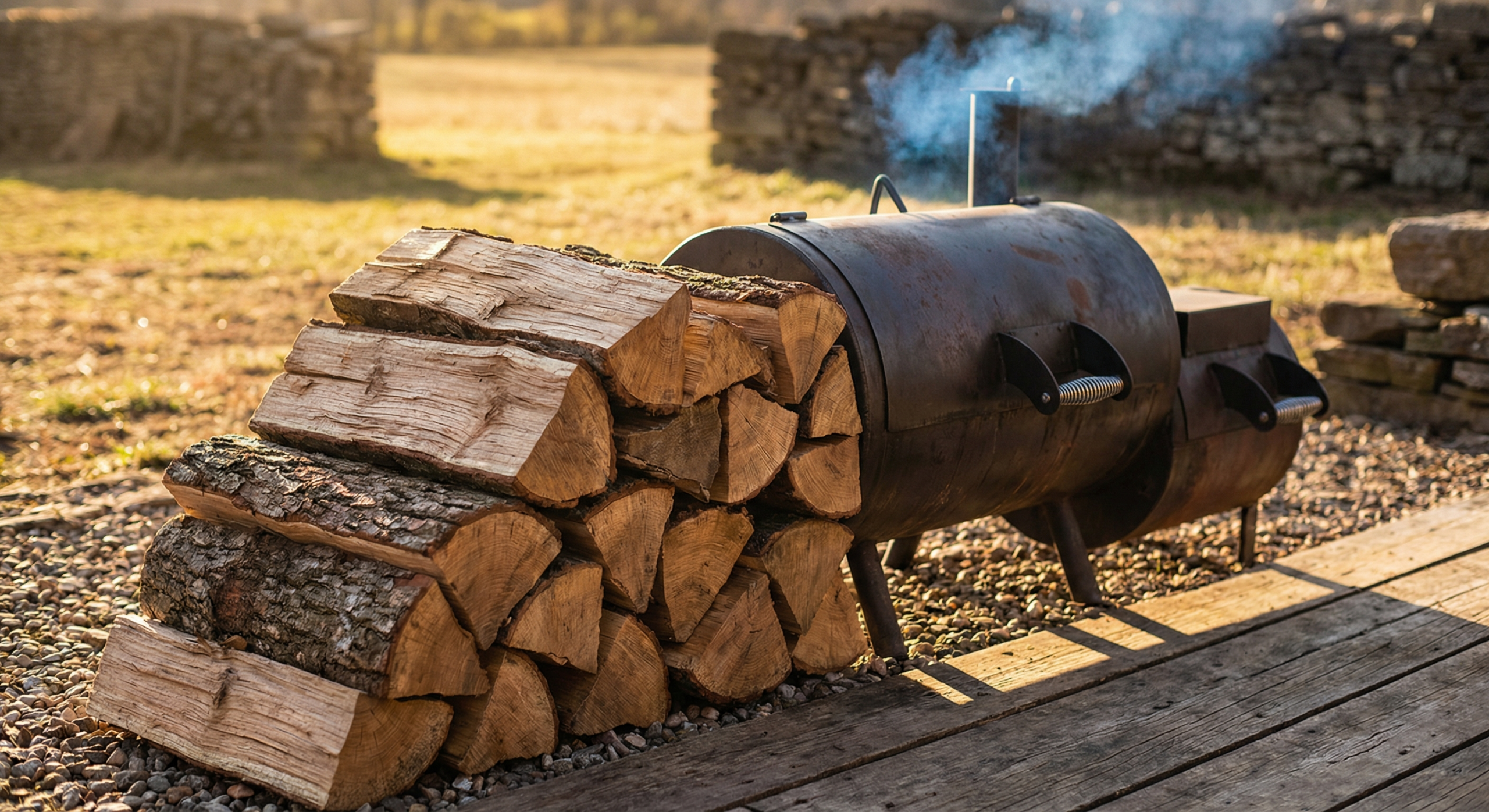
Choosing the right offset smoker wood is one of the most important decisions you’ll make when smoking meat. While your offset smoker handles airflow and heat distribution, the wood you burn determines the flavor profile of your food. Here’s what every pitmaster needs to know to select the best wood for offset smokers.
Understanding Wood Density and Burn Characteristics
Not all woods burn the same way in an offset smoker. Denser hardwoods like oak and hickory burn slower and produce more consistent heat, making them ideal for long cooks. Lighter woods like fruit woods (apple, cherry) burn faster but add delicate sweetness that complements poultry and pork.
High-density woods (oak, hickory, mesquite): Best for beef, game, and extended smoking sessions. These provide a strong smoke flavor and excellent coal production for your offset smoker. According to USDA food safety guidelines, maintaining consistent temperatures is critical for safe smoking.
Medium-density woods (pecan, maple): Versatile options that work well with almost any protein. Pecan offers a milder version of hickory’s nuttiness.
Fruit woods (apple, cherry, peach): Lighter smoke with subtle sweetness. Perfect for chicken, turkey, pork, and fish. Cherry adds a beautiful mahogany color to the bark.
Why Properly Seasoned Offset Smoker Wood Matters
Never burn green (freshly cut) wood in your offset smoker. Green wood contains too much moisture—often 50% or more by weight. This excess water creates steam instead of clean smoke, resulting in bitter, acrid flavors and inconsistent temperatures.
Properly seasoned offset smoker wood should have a moisture content between 15-20%. You can tell wood is ready when:
The ends show visible cracks
The bark peels away easily
Two pieces knocked together produce a sharp “crack” rather than a dull thud
It feels significantly lighter than green wood of the same size
Plan to season your wood for 6-12 months, stored off the ground with good airflow. Buying pre-seasoned splits from a reputable supplier is worth the investment if you’re not able to season your own.
Regional BBQ Wood Pairings
Traditional BBQ regions developed their offset smoker wood preferences based on what grew locally:
Texas: Post oak is king—clean-burning with moderate smoke flavor that lets beef shine
Kansas City: Hickory dominates, providing bold smoke that pairs with sweet, thick sauces
Carolinas: Oak and hickory for whole hog, with fruit woods gaining popularity
Memphis: Hickory and pecan for ribs and pulled pork
Practical Tips for Selecting Offset Smoker Wood
Start with oak. If you’re new to offset smoking, oak is the most forgiving wood. It burns clean, produces consistent heat, and delivers a universally appealing smoke flavor that won’t overpower your meat.
Mix woods intentionally. Many competition pitmasters blend woods—oak as a base for consistent heat, with fruit wood added for complexity. A 70/30 oak-to-cherry ratio is a proven combination for pork.
Match intensity to cook time. For quick smokes (ribs, chicken), lighter fruit woods work well. For 12+ hour brisket cooks in your offset smoker, you need the sustained heat and deeper flavor of oak or hickory.
Avoid softwoods entirely. Pine, cedar, fir, and other conifers contain resins that produce toxic smoke and coat your food with unpleasant residue. Stick to hardwoods only for your offset smoker wood supply.
Best Wood Split Sizes for Offset Smokers
For offset smokers, splits (logs cut into quarters) are the standard fuel. The ideal offset smoker wood size depends on your firebox:
Small fireboxes (90-120 gallon cookers): 12-14″ splits, 3-4″ diameter
Large fireboxes (180-250 gallon cookers): 16-18″ splits, 4-6″ diameter
Consistent split sizes help maintain steady temperatures. When all your offset smoker wood is roughly the same dimensions, you can predict how the fire will behave when you add fuel—crucial for managing long cooks without temperature spikes.
Building Your Offset Smoker Wood Supply
Serious pitmasters maintain a rotating stock of seasoned wood. Aim to have at least two types on hand—a workhorse like oak plus a flavor wood for variety. Store your splits in a covered area with sides open for airflow, keeping the oldest wood accessible so you use it first.
The right offset smoker wood, properly seasoned and matched to your protein, is what separates good barbecue from great barbecue. Take the time to source quality fuel, and your offset smoker will reward you with consistently excellent results.
Frequently Asked Questions About Offset Smoker Wood
What is the best wood for offset smokers?
Oak is the best all-around offset smoker wood for beginners—it burns clean, provides consistent heat, and works with any meat. For beef, try post oak or hickory. For pork and poultry, fruit woods like apple or cherry add pleasant sweetness.
How long should wood be seasoned before using in a smoker?
Wood should be seasoned for 6-12 months before burning in your offset smoker. Properly seasoned wood has 15-20% moisture content. Look for cracked ends, loose bark, and a lighter weight compared to green wood.
Can you mix different woods in an offset smoker?
Yes, mixing woods is a common technique among competition pitmasters. Use a base wood like oak for consistent heat (about 70%), then add fruit woods like cherry or apple (about 30%) for added flavor complexity.
Ready to Start Smoking?
At Vanport Pits, we build custom offset smokers designed for optimal airflow and heat management—so you can focus on perfecting your wood selection and technique. Browse our collection or contact us about a custom build tailored to your specific needs.
Technical Fluid Dynamics of the ‘Stack Effect’; The Trade-Off Between Fuel Efficiency and Convective Velocity; Impact of ‘Tuning Plates’ on Airflow Drag
There is a moment in every pitmaster’s journey when they stop looking at the fire and start visualizing the air. We often romanticize the wood and the meat, but the true engine of a professional offset smoker is invisible. It is offset smoker fluid dynamics.
The difference between “good” BBQ and “legendary” BBQ isn’t just about a secret rub; it is about how efficiently you can move a fluid (air) through a heated cylinder to achieve clean combustion and convective heat transfer. Today, we are moving beyond the basics to explore the physics that power your pit, from the vacuum of the stack effect to the friction penalties of tuning plates.
The Physics of the ‘Stack Effect’: Powering the Smoker’s Natural Draft
At its core, an offset smoker is a machine designed to exploit a pressure differential. This phenomenon, known in engineering circles as the “stack effect” or “chimney effect,” is the primary driver of airflow in your pit.
It works on a simple principle: as combustion occurs within the firebox, the gases expand and their density decreases relative to the cooler ambient air outside. This hot, buoyant air rises through the smokestack, creating a vacuum—a pressure drop—at the base of the stack. This vacuum pulls fresh oxygen into the firebox intake to fuel the fire, pulls the heat across the cooking grates, and exhausts the byproducts.
Volume-to-Height Ratios
Professional fabricators don’t just guess at smokestack dimensions; they engineer them. The strength of the draft is proportional to the height and interior volume of the stack. For standard horizontal backyard units, fabricators typically aim for a stack height of 40 to 50 inches to optimize this draft.
The Undersized Stack: If the stack is too short or narrow, the pit cannot breathe. This leads to oxygen deprivation in the firebox, resulting in incomplete combustion and “dirty,” bitter white smoke.
The Oversized Stack: Conversely, a stack that is too tall can cause combustion gases to cool excessively before they exit. Cool air is heavier; if it lingers in the stack, it creates backpressure that “stalls” the airflow.
Convective Velocity vs. Fuel Efficiency: The Great Smoker Trade-Off
In smoker engineering, there is always a trade-off. One of the most critical is the balance between how fast the air moves (convective velocity) and how much wood you burn (fuel efficiency). Understanding offset smoker fluid dynamics helps you manage this balance.
Thermal Mass as a Battery
Premium smokers are often built from heavy-gauge American steel, typically 1/4″ or 3/8″ thick. This steel acts as a massive thermal battery.
Thicker steel takes significant energy to heat up. However, once saturated, it becomes impervious to wind and cold, stabilizing temperature swings. Conversely, slightly thinner 1/4″ rolled steel emphasizes rapid airflow response. These pits heat up faster and allow the pitmaster to make quick adjustments to the fire that are immediately reflected in the cook chamber.
Impact of ‘Tuning Plates’ on Airflow Drag and Temperature Gradients
For decades, pitmasters have used “tuning plates”—movable steel baffles located under the grates—to force an offset smoker to cook evenly. While effective at evening out temperatures, they introduce a fluid dynamics problem: drag.
The Friction Penalty
Every object you place in the path of the airflow creates friction. Tuning plates force the air to squeeze through small gaps, creating turbulence and slowing down the overall velocity of the smoke stream. This “friction penalty” can reduce the total volume of clean smoke washing over your meat.
Architectural Fluid Dynamics: Traditional vs. Reverse Flow Engineering
The debate between traditional and reverse flow smokers is essentially a debate about airflow pathing. In traditional systems, the linear path offers the lowest resistance, which is a hallmark of efficient offset smoker fluid dynamics.
Reverse flow engineering forces the hot gases to travel under a solid baffle plate, hit the far wall, and turn 180 degrees. While this ensures extreme temperature uniformity, the trade-off is efficiency and fuel consumption. Whether you prefer the linear path or the uniformity of reverse flow, we scale these principles up for professional use. Beyond the Backyard: Custom 250-Gallon and Trailer-Mounted Builds.
Advanced Optimization: CFD Modeling and Weather Resistance
The future of smoker design isn’t just welding; it’s software. Engineers are now using Computational Fluid Dynamics (CFD) tools to model the inside of smokers before a single piece of steel is cut.
CFD modeling has revealed that airflow in a horizontal pipe often forms a “high-velocity jet” along the top of the chamber. This is why the best modern pits feature a “grate-level exhaust.” By placing the exhaust intake down at the grate level, the physics force that hot, smoky air to pull down through the food, ensuring maximum flavor absorption.
Ready to master the airflow in your backyard?
Understanding the science is the first step, but cooking on a machine built to harness these principles is the game-changer. At Vanport Pits, we prioritize engineering that respects the laws of thermodynamics to give you the cleanest burn possible.
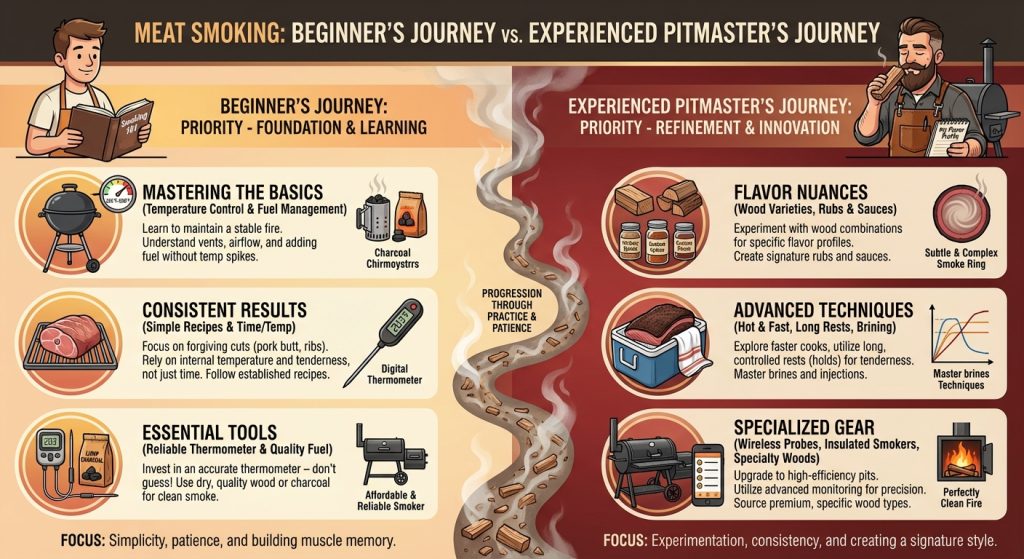
Meat Smoking for Beginners vs. Experienced Pitmasters: Prioritizing Your Journey
Smoker buying tips for beginners vs pros highlight different priorities when selecting an offset smoker for backyard cooking or pro-level consistency.
Meat smoking is a revered culinary art—often challenging for newcomers, yet deeply rewarding. Unlike grilling or roasting, smoking offers little immediate feedback and requires hours of patient attention, which makes the learning curve feel steep for many aspiring pitmasters.
Success in meat smoking is not just about knowing how to smoke meat—it is about understanding and prioritizing the right skills at each stage of your journey. A beginner obsessing over advanced wood blends may miss crucial temperature fundamentals, while an expert neglecting the basics can still produce inconsistent results.
This article outlines the distinct priorities for beginner meat smokers compared to the refined focus of experienced pitmasters. By understanding how priorities shift over time, you can accelerate learning, avoid common pitfalls, and improve results faster.
Beginner Meat Smoking Priorities: Building Your Foundation
For those new to slow-smoked meats, establishing a solid foundation is critical. Beginner meat smoking tips emphasize consistency and simplicity to build confidence and develop reliable habits.
Mastering Smoker Temperature Control
Temperature consistency is the single most important skill for beginners. Experienced pitmasters can recover from swings; beginners often cannot yet tell when intervention helps versus when it makes things worse.
Learning how your smoker’s dampers and vents affect airflow and heat is foundational:
The top vent controls how much heat escapes
The bottom vent regulates oxygen flow to the fire
Small changes have delayed effects—typically taking 10–15 minutes to show results.
Maintaining a consistent range (often within 25°F of target) matters more than hitting a perfect number. A smoker holding 225–250°F reliably will outperform one that swings between 200°F and 300°F.
Essential Smoker Equipment for Beginners
Beginners benefit most from forgiving equipment that holds temperature with minimal intervention. That might mean starting with an electric smoker or pellet grill rather than an offset stick burner.
Fuel types also shape the learning curve:
Charcoal provides traditional flavor but requires active management
Wood demands the most skill but offers maximum flavor control
Propane and electric sacrifice some flavor complexity for consistency and convenience
The most important beginner tool is a reliable dual-probe thermometer—one probe for smoker temperature and one for meat internal temperature.
Best Meats for Beginners: Building Confidence
Pork shoulder (pork butt) is ideal for beginners: inexpensive, forgiving, and difficult to ruin. High fat and connective tissue keep it moist even with minor errors.
Chicken quarters or whole chickens are also excellent: shorter cook times provide faster feedback and visible cues—especially if the skin crisps correctly.
Avoid starting with brisket or ribs. Brisket requires precise control and timing. Ribs demand familiarity with bend tests and wrapping judgment.
Following Proven Meat Smoking Recipes and Methods
Beginners should avoid innovation early on. Established meat smoking recipes exist because they work consistently and teach cause-and-effect.
Following a recipe exactly establishes a baseline. When something goes wrong, you can identify what changed. Introducing multiple variables at once makes learning from mistakes nearly impossible.
Time and temperature guidelines are practical wisdom, not arbitrary suggestions. For example: a pork shoulder at 225°F typically takes 1.5–2 hours per pound.
Cultivating Patience and Discipline in Smoking
Opening the smoker drops temperature and extends cook time. Each peek can add 15–20 minutes.
Low-and-slow is not just about heat—it is about trusting the process. Many beginners sabotage results through constant monitoring and repeated vent adjustments.
Make one change, then wait 15 minutes before judging the effect.
Understanding Basic Smoke Management
Thin blue smoke is the goal. It indicates clean combustion and produces pleasant flavor.
Thick white smoke signals incomplete combustion and can create bitter, acrid results.
Over-smoking is a common beginner issue. More smoke does not equal better flavor—it often produces harshness. Most smoke absorption happens early in the cook when the surface is moist.
Start with milder woods such as apple, cherry, or pecan. Strong woods like hickory or mesquite can overwhelm meat and amplify mistakes.
Experienced Pitmaster Skills: The Value of Mastery
Once fundamentals become automatic, experienced pitmasters shift priorities toward intuition, efficiency, and creative expression. Advanced smoking becomes less about survival and more about control and refinement.
Advanced Fire and Heat Management
Experienced pitmasters develop intuition for fire behavior. They can read coals quickly and anticipate the next adjustment.
They also compensate naturally for weather variables such as wind, humidity, and ambient temperature—often adding fuel before temperatures drop.
Experts can manage multiple temperature zones in a single cook, juggling meats with different needs.
Expert Fuel and Wood Selection for Smoking
Experienced pitmasters treat wood selection as both flavor and performance engineering. They understand:
How oak provides a neutral, stable base
How pecan adds subtle sweetness without cherry’s intensity
How blends create layered complexity
They also account for burn rate, heat output, and moisture content, and they evaluate fuel quality with more precision.
Mastering the Stall: Advanced Intervention Techniques
The stall becomes a tool rather than a surprise. Experts understand evaporative cooling and use the stall to manage bark development and timing.
Knowing when to wrap versus pushing through separates competent cooks from masters:
Wrapping speeds cooking but softens bark
Pushing through preserves bark but costs time and fuel
Experts also recognize that stall behavior changes by meat type and humidity.
Developing a Signature Pitmaster Style and Flavor Profile
Experienced pitmasters develop a signature: custom rubs, injection styles, wood blends, and repeatable workflows.
At this stage, experimentation is controlled. Experts change one variable at a time, document outcomes, and understand why results shifted.
Breaking “rules” works only after mastering them.
Reading Meat: Beyond the Thermometer
Experts use thermometers, but doneness decisions often rely more on tactile and visual cues:
Brisket probe tender “like butter”
Ribs bend test
Jiggle test
Bark color, texture, tackiness
These cues provide information thermometers cannot.
Optimizing Smoking Efficiency and Workflow
Experienced pitmasters run systems. They know which meats tolerate fluctuations, which finish together, and how to stagger starts to hit serving time.
Efficiency also includes fuel precision—loading enough to run cleanly without waste.
Advanced Moisture and Tenderness Techniques for Meat
Experts apply moisture strategies deliberately:
Injections (timing and formulation)
Spritzing or mopping (frequency and purpose)
Collagen breakdown understanding per cut
They know when tenderness gains are worth pushing temperature—and when it risks drying out.
Common Meat Smoking Mistakes: Beginner vs. Expert Pitfalls
Understanding common smoking mistakes helps both novices and seasoned cooks avoid setbacks.
Common Beginner Meat Smoking Mistakes
Over-complicating the process by adopting advanced techniques too early
Inconsistent temperature control and chasing exact numbers
Opening the smoker too often out of anxiety
Using too much wood or overly strong woods, leading to bitter flavor
Assuming techniques translate across smoker types without adjustment
The Transition: From Beginner to Advanced Pitmaster
Progress is continuous and marked by discipline, repetition, and structured learning.
Signs You’re Ready to Advance
Consistent success with basic cuts
Ability to explain why the last cook succeeded or failed
Less obsessive thermometer-checking and more controlled interventions
Intermediate Pitmaster Skills to Develop
Expanding to brisket and ribs after mastering pork shoulder
Purposeful rub and seasoning experimentation
Recovery skills when things go wrong (spikes, fuel issues, timing problems)
Building Meat Smoking Experience Systematically
A smoking journal accelerates learning. Track:
Temperatures and timing
Weather conditions
Fuel use
Results and notes
Photos of bark and finished slices
Failures teach more than lucky wins.
Smoker Equipment: Beginner vs. Expert Perspectives
Equipment needs shift as skills evolve.
Beginner Smoker Equipment Focus
Reliable temperature control
Ease of use and cleanup
Forgiving design features (seals, water pans, usable fuel space)
What Experienced Pitmasters Look For in Equipment
Versatility and customization
Heavy-gauge steel and long-term durability
Capacity for advanced techniques and large cooks
Access to fire without disrupting food
Meat Smoking: The Role of Theory vs. Practice
Both matter, but their weighting changes over time.
Why Beginners Benefit from Theory
Understanding smoke adhesion and timing
Food safety fundamentals
Recipes and ranges as guardrails
Why Experts Rely More on Practice
Intuition and muscle memory
Automatic adjustment to variables
Flexibility beyond recipes when real conditions differ
Universal Principles for Every Meat Smoker
Some principles never change.
Fundamental Principles for All Pitmasters
Food safety always comes first
Quality meat matters at every level
Patience is non-negotiable
Consistent practice builds and maintains skill
Frequently Asked Questions About Meat Smoking
How long does it take to go from beginner to experienced pitmaster?
Most people reach intermediate skill after 20–30 cooks over 1–2 years. Expert level often takes 3–5 years and hundreds of cooks, especially across different meats and conditions.
What’s the most important skill for a beginner to master first?
Temperature control. Keep your smoker within 25°F of target before worrying about advanced techniques.
Do experienced pitmasters still use thermometers?
Yes, but typically for confirmation rather than sole decision-making.
Should beginners invest in expensive equipment?
No. Beginners benefit more from forgiving equipment they will use often. A quality thermometer is a better early investment.
What meat should absolute beginners start with?
Pork shoulder. It is forgiving, inexpensive, and yields clear feedback on technique.
How do you know when you’re ready to experiment with techniques?
When you produce consistent results and can explain why cooks succeed or fail.
Do pitmasters ever go back to beginner techniques?
Yes—especially when troubleshooting or teaching. Fundamentals remain essential.
What separates a good pitmaster from a great one?
Consistency across different conditions, meats, and equipment—not occasional success.
Key Takeaways for Your Meat Smoking Journey
Beginners should prioritize consistency, temperature control, and basic technique above all else
Experienced pitmasters prioritize intuition, workflow, and controlled experimentation
The transition requires systematic learning, documentation, and reflection on failures
Fundamentals like food safety, patience, and meat quality matter at every level
Equipment priorities shift from forgiving simplicity to durability, versatility, and control
Patience remains essential from your first cook to your thousandth
The fastest growth comes from focusing on the skills appropriate to your current stage
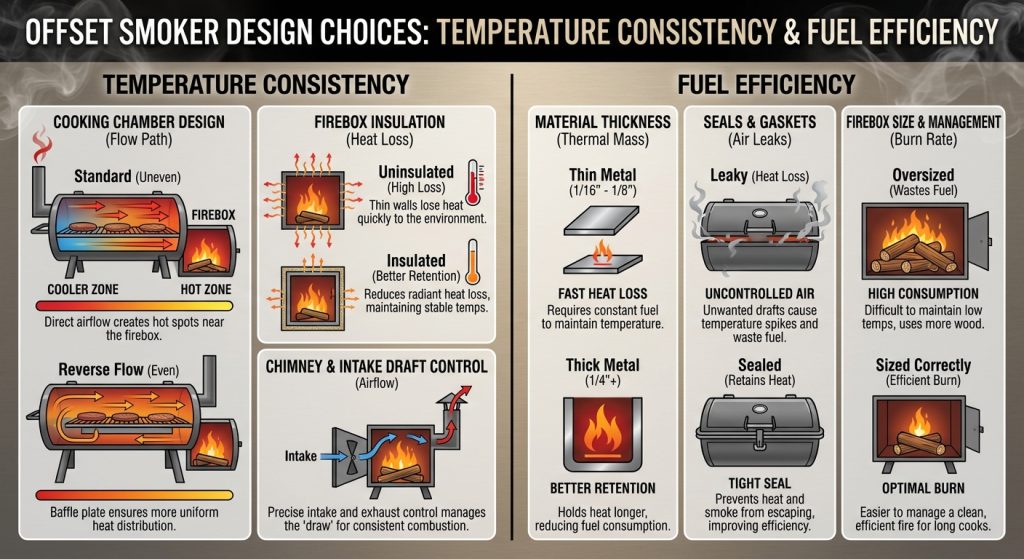
What Design Choices Impact Temperature Consistency and Fuel Efficiency
Offset smoker design choices significantly influence temperature consistency and fuel efficiency, and understanding these fundamentals improves your BBQ performance.
The performance of modern heating systems, appliances, and industrial equipment depends heavily on thoughtful design decisions made during development. In effective heating system design, two critical performance metrics consistently stand out: temperature consistency and fuel efficiency.
Temperature consistency refers to a system’s ability to maintain stable, predictable temperatures without large fluctuations. Fuel efficiency measures how effectively a system converts fuel into usable heat rather than waste. These two metrics are closely linked—design choices that improve one often enhance the other.
Understanding which thermal design principles most strongly influence these outcomes allows engineers, manufacturers, and end users to make informed decisions about system selection, installation, and operation.
offset smoker temperature consistency
Understanding Temperature Consistency in Heating Systems
Temperature consistency describes a system’s capacity to maintain uniform heat output over time and across varying operating conditions. It is typically measured by tracking deviations from target temperatures or fluctuation ranges over defined periods.
Consistent temperatures improve comfort, increase process reliability, ensure product quality, and reduce mechanical stress on components across residential, commercial, and industrial applications.
Key Factors Affecting Temperature Consistency
Thermal mass Thermal mass is the amount of material available to absorb and store heat. Greater thermal mass buffers temperature fluctuations by absorbing excess heat during high-output periods and releasing it during pauses in combustion or heating cycles.
Material mass, density, and specific heat capacity all contribute, making material selection a foundational thermal design decision.
Heat distribution mechanisms Heat distribution determines how thermal energy moves through a system and into the surrounding space. Effective distribution prevents hot spots and cold zones, promoting uniform temperatures.
This includes:
Convective airflow patterns
Radiant heat transfer pathways
Environmental Influences on Temperature Stability
External factors such as ambient temperature, wind, humidity, and barometric pressure significantly affect internal temperatures. Well-designed systems mitigate these influences and maintain stable output despite changing conditions.
Common instability issues include:
Rapid cycling
Slow response to load changes
Uneven heat distribution
Difficulty maintaining setpoints under variable conditions
Understanding Fuel Efficiency in Heating System Design
Fuel efficiency measures how much useful heat a system produces per unit of fuel consumed. It is usually expressed as a percentage comparing delivered heat to the theoretical energy content of the fuel.
Modern systems typically achieve 60–95% efficiency, depending on design. Condensing technologies reach the upper end by capturing latent heat from exhaust gases.
Economic and Environmental Benefits
Higher efficiency lowers operating costs and reduces emissions per unit of useful heat. These benefits have driven stricter efficiency standards and regulations across heating system categories.
Key Determinants of Fuel Efficiency
Energy conversion rates Efficient systems convert chemical or electrical energy into heat with minimal losses. Complete combustion, optimal flame temperatures, and fewer intermediary steps improve conversion rates.
Heat loss prevention Preventing heat loss keeps generated heat inside the system and directed toward useful output. Key elements include:
Insulation
Exhaust management
Structural thermal barriers
Combustion or energy-transfer optimization Fuel-burning systems rely on optimized combustion, while electric systems focus on efficient energy transfer. Both aim to maximize usable heat output.
Insulation Design Choices for Maximum Efficiency
Insulation is one of the most impactful design elements affecting both temperature consistency and fuel efficiency. Proper insulation reduces heat loss, stabilizes internal temperatures, and maximizes usable output.
Insulation Material Selection
Common insulation types include:
Fiberglass and mineral wool – moderate resistance at reasonable cost
Ceramic fiber and refractory materials – high-temperature capability
Closed-cell foam and vacuum panels – high R-value in compact spaces
R-value measures thermal resistance, while thermal conductivity becomes more important at high operating temperatures.
Optimal Insulation Thickness and Placement
Increasing insulation thickness generally improves performance, but benefits diminish beyond a certain point. Economic analysis identifies a balance between performance, cost, and space.
Strategic placement prioritizes:
External surfaces
High temperature differentials
Large surface areas
Common Insulation Design Mistakes
Avoid:
Inadequate insulation around doors and access points
Thermal bridges from gaps in coverage
Compressed insulation reducing effectiveness
Failure to account for thermal expansion
Combustion Chamber and Heat Exchanger Design
The combustion chamber and heat exchanger form the core of fuel-burning systems, directly determining how efficiently fuel converts to heat and how effectively that heat transfers.
Combustion Chamber Configuration
Key design considerations include:
Adequate volume for complete combustion
Geometry that supports flame development
Sufficient residence time
Airflow design balances oxygen supply for complete combustion without excessive excess air.
Material selection balances durability, heat retention, and structural integrity. Refractory and high-mass materials improve combustion efficiency by maintaining elevated temperatures.
Heat Exchanger Design Principles
Heat transfer surface area Larger surface areas extract more heat from exhaust gases, improving efficiency—though excessive area may cause condensation issues.
Flow path optimization Baffles, turbulence enhancers, and directional changes increase heat transfer without excessive pressure drop.
Counter-flow designs Opposing flow directions maintain a strong temperature gradient and improve overall heat transfer effectiveness.
Airflow and Ventilation Design
Proper airflow directly affects combustion efficiency and heat distribution.
Air Intake Design
Primary air controls burn rate and heat output
Secondary air completes combustion of volatiles
Adjustable systems allow optimization across conditions
Insufficient air causes incomplete combustion; excessive air wastes heat.
Exhaust and Ventilation Systems
Draft optimization ensures efficient exhaust without excessive heat loss. Systems may use natural or forced draft.
Heat recovery captures energy from exhaust gases, with condensing systems exceeding 90% efficiency.
Structural and Material Design Choices
Material and structural decisions define thermal performance, durability, and long-term efficiency.
Material Selection for Heat-Exposed Components
Thermal conductivity determines heat retention or transfer
Durability and heat resistance ensure longevity
Mass and heat retention stabilize temperatures
Structural Design for Heat Distribution
Intentional design of heat pathways and barriers prevents unwanted loss.
Thermal bridging, caused by conductive elements bypassing insulation, must be minimized using thermal breaks and strategic placement.
Control Systems and Automation
Automation significantly improves both consistency and efficiency through precise, continuous adjustment.
Automated feeding improves stability in solid-fuel systems
Consistent supply improves combustion quality
Size and Capacity Considerations
Proper sizing is fundamental.
Right-Sizing for Application
Oversizing causes cycling losses and instability
Undersizing prevents meeting peak demand
Load matching ensures efficient operation
Volume-to-Surface Area Ratios
Compact shapes reduce heat loss. Cylindrical and cubic forms typically offer favorable ratios.
Sealing and Air Leakage Prevention
Air leaks waste fuel and destabilize temperatures.
Door and Access Point Design
High-temperature gasket materials
Replaceable and adjustable seals
Loading mechanisms that minimize heat loss
Joint and Connection Sealing
Designs must accommodate thermal expansion without creating gaps. Accessible seals encourage maintenance and sustained efficiency.
Thermal Mass and Heat Storage Design
Thermal mass acts as a heat battery, smoothing fluctuations and extending usable heat delivery.
Heat Storage Capacity
High-mass materials store and release heat gradually, improving consistency and fuel utilization.
Passive Heat Distribution
Optimized natural convection
Radiant heat surface design
Enhanced natural circulation pathways
External Design Factors
Environmental conditions and installation context influence performance.
Environmental Protection Design
Weather protection without restricting ventilation
Strategic installation location
Seasonal adaptation features
Aesthetic vs Performance Balance
Successful designs integrate form and function without compromising thermal efficiency or usability.
Maintenance and Longevity Design
Long-term performance depends on durability and maintainability.
Cleanability and Access
Accessible inspection points
Easy cleaning of heat-exchange surfaces
Efficient ash removal
Component Replaceability
Modular design
Accessible wear components
Sustained efficiency over decades
Frequently Asked Questions
How does insulation thickness affect temperature consistency and fuel efficiency?
Thicker insulation reduces heat loss and stabilizes internal temperatures, improving both metrics—though returns diminish beyond a certain point.
What design choice most improves fuel efficiency?
Comprehensive heat-loss prevention—insulation, sealing, heat exchange, and proper sizing—offers the greatest gains.
Can consistency improve without affecting efficiency?
Yes, but many improvements benefit both. Thermal mass and advanced controls primarily enhance consistency.
How do materials affect long-term performance?
Durable, heat-resistant materials maintain efficiency and structural integrity over time.
What role does automation play?
Automation maintains tight temperature bands and optimizes fuel use through continuous modulation.
Key Takeaways
Temperature consistency depends on thermal mass, insulation, sealing, and responsive controls
Fuel efficiency relies on heat-loss prevention, optimized combustion, efficient heat exchange, and proper sizing
Many design choices improve both metrics simultaneously
Highest ROI improvements include insulation, sealing, right-sizing, and control accuracy
Future trends include advanced materials, smart controls, heat recovery, and performance monitoring systems that maintain efficiency over the system’s lifetime.
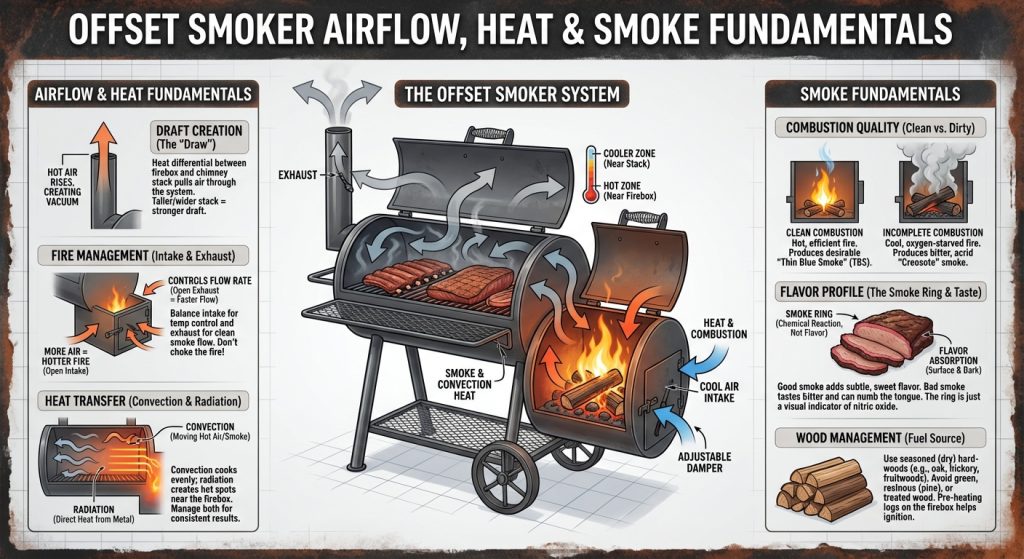
Offset smoker airflow fundamentals explain how heat and smoke move through an offset smoker and why airflow control matters for consistent cooking results.
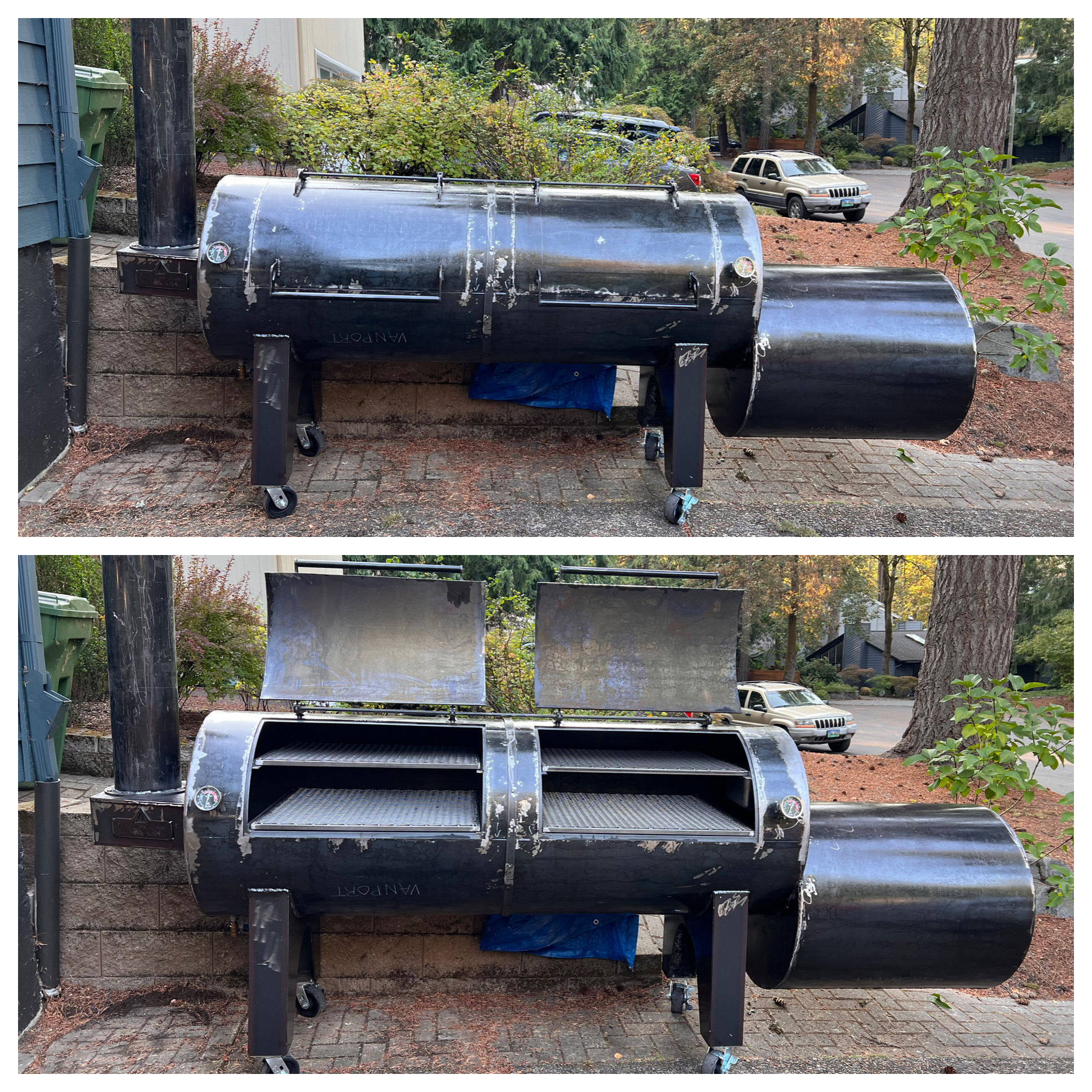
An offset smoker is a horizontal, barrel-style cooker with a firebox attached to one side and a chimney on the opposite end. This layout separates the heat source from the cooking area, enabling true indirect smoking.
Understanding how smoke and heat move through an offset smoker turns barbecue from guesswork into controlled execution. Once you know why certain areas run hotter and others cooler, you can place meat intentionally, manage fire more efficiently, and achieve consistent results.
Heat and smoke movement in an offset smoker follows basic physics. Hot air rises and moves toward lower-pressure areas, carrying smoke particles with it. At the same time, the smoker’s metal construction conducts and radiates heat, creating the distinctive cooking environment inside the chamber.
Understanding airflow is a key part of choosing the right smoker, because heat movement, draft, and smoke circulation directly affect temperature stability and fuel efficiency.
Key Components of an Offset Smoker
To understand offset smoker heat and smoke flow, you must first understand its primary components.
The Firebox Chamber
The firebox is a smaller chamber attached to one end of the main barrel where wood splits or charcoal burn. It includes an adjustable air intake vent that controls oxygen supply to the fire.
The firebox connects to the cooking chamber through an opening, typically positioned low on the shared wall.
The Cooking Chamber
The cooking chamber is the main horizontal cylinder where food rests on one or more cooking grates. Most offset smokers position the cooking chamber floor slightly higher than the firebox floor, though designs vary.
The Chimney / Exhaust Stack
The chimney, or exhaust stack, allows smoke and combustion gases to exit the cooker. It usually includes an adjustable damper to control exhaust flow.
In traditional offset smokers, the chimney is located at the end of the cooking chamber opposite the firebox.
The Firebox-to-Cooking Chamber Passage
The opening between the firebox and cooking chamber is critical for efficient heat and smoke transfer. This passage is usually low on the cooking chamber side, allowing hot gases to enter naturally.
Its size and position strongly influence offset smoker heat distribution across the chamber.
How Heat Moves Through an Offset Smoker
Heat transfer occurs through three mechanisms: convection, conduction, and radiation.
Convection: The Primary Heat Transfer Method
Convection is the dominant form of offset smoker heat transfer. Hot air produced by the fire becomes less dense and rises, creating pressure that pushes it through the connecting passage into the cooking chamber.
Once inside, hot air continues flowing toward the chimney. Rising gases inside the chimney create negative pressure, pulling air through the system in a continuous draft.
The temperature difference between the firebox and outside air directly affects this convection current, which explains why offset smokers behave differently in summer versus winter conditions.
Conduction Heat Transfer
Heat conducts through the smoker’s metal structure. Firebox walls absorb heat from the fire and transfer it through the steel into the cooking chamber walls.
Cooking grates absorb heat from passing air and radiate it upward into the meat.
Thicker steel retains heat better and improves stability but requires more time and fuel to reach cooking temperature. Thinner steel heats faster but loses heat quickly, especially in cold or windy conditions. Smoker construction quality directly impacts both stability and efficiency.
Radiant Heat Effects
Radiant heat comes from several sources:
Direct radiation from the firebox opening
Heated cooking chamber walls emitting infrared energy
Hot coals and burning wood inside the firebox
Radiant heat is strongest near the firebox side, creating the well-known hot spot, and gradually weakens toward the chimney end.
How Smoke Moves Through an Offset Smoker
Understanding smoke flow is just as important as understanding heat movement.
The Smoke Generation Process
Smoke forms during incomplete combustion of wood. Efficient combustion produces thin blue smoke, which is nearly invisible and rich in desirable flavor compounds.
Thick white smoke indicates poor combustion caused by insufficient heat or oxygen and results in bitter, acrid flavors.
Smoke quality is a direct reflection of fire management.
Smoke Flow Dynamics
Smoke particles travel with hot air through convection. As hot gases move from the firebox into the cooking chamber, smoke swirls around the food before exiting through the chimney.
Natural draft drives this movement. Rising hot gases in the chimney create lower pressure inside the cooking chamber, pulling smoke efficiently through the system.
Food placement and chamber obstructions influence turbulence, which can either improve smoke distribution or create dead zones.
The Role of the Chimney
The chimney is the engine that drives smoke movement. Taller chimneys generally create stronger draft, assuming sufficient internal temperature.
Chimney diameter affects flow volume, while placement determines the overall smoke path. Traditional offset smokers use horizontal flow from firebox to chimney, which ensures full exposure but creates temperature gradients.
Understanding offset smoker airflow fundamentals helps you diagnose hot spots and adjust firebox damper settings during long cooks.
The intake damper controls oxygen supply. More air produces hotter, cleaner fires; too little air creates dirty smoke.
The exhaust damper controls how quickly smoke and heat leave the cooker. Strong draft increases airflow; restricted exhaust retains heat but risks smoke stagnation.
Balancing intake and exhaust is essential for stable offset smoker temperature control.
Temperature Gradients in the Cooking Chamber
Offset smokers naturally develop temperature differences:
Firebox side is hottest
Chimney side is coolest
Top of chamber is warmer than bottom
Differences of 50–75°F across the chamber are common in unmodified smokers.
External Environmental Factors
Wind, ambient temperature, humidity, and precipitation all affect offset smoker airflow and performance. Wind can dramatically increase or disrupt draft, while cold weather increases heat loss through metal walls.
Experienced pitmasters adapt fire management to prevailing conditions.
Common Smoke and Heat Flow Problems
Poor Draft and Smoke Back-Up
Smoke backing into the firebox indicates draft problems, often caused by insufficient chimney height, blockages, or adverse wind conditions.
Uneven Heat Distribution
Hot spots near the firebox and cold spots near the chimney are normal but manageable. Side-to-side variations may result from airflow imbalance or chamber geometry.
Excessive Heat Loss
Common causes include:
Poor door and lid seals
Thin steel construction
Leaks at the firebox-to-chamber connection
Many factory smokers benefit from gasket upgrades.
Optimizing Smoke and Heat Flow
Modifications to Improve Flow
Baffle plates and tuning plates redistribute heat by blocking direct radiant exposure and forcing lateral airflow.
Some setups create reverse flow, where gases travel under a plate before rising and flowing back toward the chimney.
Chimney extensions or repositioning can significantly improve draft and smoke flow.
Fire Management Techniques
Small, clean-burning fires are more efficient than large fires choked by dampers. Fire placement within the firebox affects radiant heat and temperature control.
Dry, seasoned hardwood produces cleaner smoke and steadier heat.
Cooking Chamber Setup
Water pans act as heat sinks, stabilize temperature swings, add humidity, and block direct radiant heat.
Strategic meat placement and occasional rotation compensate for natural gradients.
Measuring and Monitoring Flow Patterns
Temperature Monitoring Strategies
Built-in dome thermometers often read hotter than grate-level temperatures. Use multiple thermometers at grate level near the firebox, center, and chimney to map heat zones accurately.
Smoke Quality Assessment
Thin blue smoke indicates clean combustion. Thick white smoke signals airflow or fire problems.
Pleasant-smelling smoke equals good combustion; acrid smoke equals trouble.
Frequently Asked Questions
Why is the firebox side always hotter?
Direct radiant heat and peak-temperature gas entry make the firebox side the hottest zone. This is normal in traditional offsets.
How does chimney position affect smoke flow?
Chimney placement determines smoke path. Traditional offsets use horizontal flow; reverse flow designs redirect gases beneath a baffle before exiting.
What is thin blue smoke?
Nearly invisible smoke from efficient combustion that delivers clean flavor without bitterness.
Can uneven heat be managed without modifications?
Yes—through fire size control, water pans, food placement, and rotation.
How do I know if draft is good?
Smooth smoke flow, stable temperatures, and thin blue smoke exiting the chimney indicate proper draft.
Does opening the cooking chamber door matter?
Yes. It disrupts pressure balance, drops temperature, and interrupts smoke flow for several minutes.
Key Takeaways
Heat moves primarily by convection, with conduction and radiation contributing
Smoke travels with hot air, driven by chimney-induced draft
Intake and exhaust control both temperature and smoke quality
Temperature gradients are normal and manageable
Baffles improve distribution, but fire management matters most
Mastering how smoke and heat move through an offset smoker allows you to cook with intention, consistency, and efficiency—hallmarks of true pit mastery.
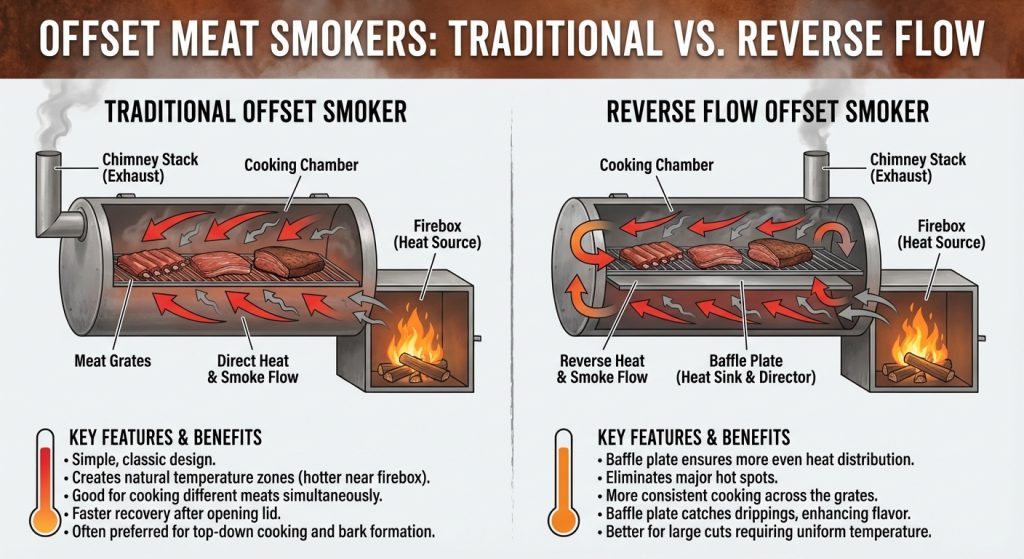
Traditional vs reverse flow smokers differ in how heat and smoke travel through the cooker, impacting temperature consistency and flavor profile.
Offset meat smokers are iconic in American BBQ, known for their traditional low-and-slow cooking. Within this popular category, a crucial distinction exists between traditional offset smokers and reverse flow smokers.
Understanding the differences between these two designs is key, as it impacts everything from temperature consistency to the flavor profile of your smoked meats. Whether you’re a beginner shopping for your first offset meat smoker or an experienced pitmaster considering an upgrade, knowing how these designs compare will help you make an informed decision.
This article will delve into the structural differences, performance characteristics, and practical considerations that set traditional offset smokers apart from their reverse flow counterparts.
What Is a Traditional Offset Meat Smoker?
A traditional offset meat smoker features a horizontal cooking chamber with a firebox attached to one side. This classic design has been the backbone of BBQ for generations, representing authentic low-and-slow cooking.
The basic operation is straightforward: you build a fire in the offset firebox using wood, charcoal, or a combination of both. Heat and smoke travel directly from the firebox into the main cooking chamber through a connecting opening.
Traditional Offset Smoker Components and Airflow
Key components include:
The firebox (where fuel burns)
The cooking chamber (where meat sits on grates)
The chimney or exhaust stack (typically positioned on the opposite end from the firebox)
In a standard offset smoker, air flows in a relatively direct path. It enters through vents in the firebox, travels horizontally through the cooking chamber, and exits through the chimney.
What Is a Reverse Flow Offset Smoker?
A reverse flow offset smoker takes the basic offset design and adds a strategic modification that fundamentally changes how heat and smoke move through the cooking chamber.
The defining feature of a reverse flow smoker is a metal baffle plate (also called a tuning plate) that runs beneath the cooking grates along the length of the chamber. This plate creates a deliberate pathway that redirects smoke and heat.
How Reverse Flow Offset Smokers Work
Instead of flowing directly from firebox to chimney, smoke is forced downward under the baffle plate, travels the full length of the cooking chamber, then rises back up at the far end before exiting through the chimney—which is repositioned near the firebox rather than at the opposite end.
This extended, reversed smoke path gives the design its name and creates a distinctly different cooking environment compared to traditional offset meat smokers.
Traditional vs. Reverse Flow: Key Structural Differences
Offset Meat Smokers: Traditional vs. Reverse Flow Designs
Understanding the structural disparities is crucial when comparing traditional offset vs. reverse flow smokers.
Firebox Position and Design
Both traditional offset and reverse flow smoker types position the firebox to one side of the cooking chamber, typically at the same height or slightly lower than the cooking surface.
The main difference lies in how the firebox connects to the chamber. Traditional offsets have a simple opening that allows direct entry. Reverse flow models may have a modified connection designed to work seamlessly with the baffle plate system.
Baffle Plate System (Core Design Difference)
This is the most significant structural difference between these two offset meat smoker designs.
Traditional offset smokers have no baffle plate. The cooking chamber is open from firebox to chimney, with grates suspended above for placing meat.
Reverse flow smokers feature a thick metal plate positioned below the cooking grates. This plate spans most of the chamber length, leaving a gap at the end opposite the firebox where smoke can rise.
The baffle serves multiple purposes:
Directing smoke flow
Distributing heat
Protecting meat from direct radiant heat
Chimney and Exhaust Placement
In traditional offset smokers, the chimney is located at the end opposite the firebox. This placement creates a natural draft that pulls smoke across the cooking surface.
Reverse flow smokers position the chimney near the firebox end, often on the same side. This counterintuitive placement makes sense when you understand the reversed smoke path—smoke travels down, along the bottom, and back before exiting near where it entered.
Heat Distribution and Temperature Consistency
Heat distribution differences represent one of the most practical distinctions between these offset meat smoker types, directly impacting smoker temperature consistency.
Traditional Offset Smoker Heat Patterns
Traditional offset smokers typically have a pronounced temperature gradient. The area closest to the firebox runs significantly hotter—sometimes 50-75°F warmer—than the far end near the chimney.
The middle section falls somewhere between these extremes. This difference matters when cooking multiple pieces of meat or when precision is important.
Reverse Flow Smoker Heat Distribution
Reverse flow smokers are known for their enhanced temperature consistency. The baffle plate acts as a heat diffuser, absorbing thermal energy and radiating it more evenly across the entire cooking surface.
Temperature variations typically stay within 15-25°F across the grates. The baffle plate also shields meat from direct radiant heat from the firebox, preventing the intense heat exposure that can dry out or overcook the side facing the fire.
In a traditional offset, you might need to rotate meat periodically or strategically place different cuts in hot and cool zones. Reverse flow designs significantly reduce or eliminate this need.
Smoke Flow Patterns and Flavor Development
The journey smoke takes through each smoker type affects both flavor development and cooking characteristics, including the much-desired smoke ring.
Traditional Offset Smoke Path
In traditional offset smokers, smoke follows a direct horizontal path from firebox to chimney. It passes over the meat once in a relatively straight line, spending less total time in the chamber before exhausting.
Reverse Flow Smoke Journey
Reverse flow systems force smoke through an extended journey. Smoke enters, travels downward, runs the full length of the chamber underneath the baffle, rises at the far end, passes over the meat, and then travels back toward the chimney.
This path is roughly twice as long. The extended smoke exposure in reverse flow smokers can produce a more pronounced smoke ring—the pink layer just beneath the meat’s surface prized in BBQ.
However, smoke flavor intensity depends on many factors beyond flow pattern alone, including wood type, fire management, and cooking duration.
Cooking Performance Differences
Temperature Control and Responsiveness
Both traditional offset and reverse flow smokers require active fire management, but they respond differently to adjustments.
Traditional offset smokers react more quickly to changes in fuel or airflow. Adding wood or adjusting vents produces relatively immediate temperature shifts. This responsiveness can be advantageous for experienced pitmasters but challenging for beginners trying to maintain steady temperatures.
Reverse flow smokers have greater thermal mass due to the thick baffle plate. This mass creates more temperature stability—beneficial for long cooks—but also means the smoker responds more slowly to adjustments.
Changes take longer to manifest, requiring a more patient, anticipatory approach. Both designs have learning curves, but they favor different skill sets.
Cooking Capacity, Efficiency, and Fuel Use
Usable cooking space is similar between comparable-sized units, though the baffle plate in reverse flow models slightly reduces vertical clearance between grates and the chamber bottom.
Fuel consumption often runs slightly higher in reverse flow smokers. The additional thermal mass of the baffle plate requires more initial energy to heat up, and maintaining that mass at temperature consumes ongoing fuel.
Heat-up time definitely favors traditional offsets. Without a baffle plate to heat, they reach cooking temperature faster—sometimes 30-45 minutes quicker than comparable reverse flow models.
Food Quality Results (Moisture, Bark, Smoke)
When properly managed, both offset meat smoker types produce excellent BBQ, though with subtle differences.
Reverse flow smokers typically provide better moisture retention. The baffle plate prevents direct heat exposure and creates a slightly more humid environment, helping meat stay juicier through long cooking sessions.
Bark formation—the flavorful crust on smoked meat—develops well on both types but may form slightly faster on traditional offsets due to more direct heat and airflow exposure.
Flavor profiles are remarkably similar when variables like wood choice and fire management are controlled. The extended smoke path in reverse flow adds slightly more smoke penetration, but this difference is subtle.
Advantages of Traditional Offset Smokers
Traditional offset smokers offer several practical benefits that appeal to many BBQ enthusiasts.
Lower Cost and Simpler Design
Cost represents a significant advantage. Without the additional baffle plate and associated modifications, traditional offsets typically cost 20-30% less than comparable reverse flow models.
The simpler design means fewer components to maintain, clean, or potentially replace. There’s an elegance to the straightforward approach that resonates with purists.
Lighter Weight, Portability, and Faster Heat-Up
Weight differences matter for portability. Without the heavy baffle plate, traditional offsets are substantially lighter—sometimes 50-100 pounds less in comparable sizes.
This makes them easier to move, position, or transport to competitions or gatherings. Faster heat-up times mean you can go from cold smoker to cooking temperature more quickly, valuable when you want to start smoking without extensive preheating.
Advantages of Reverse Flow Smokers
Reverse flow designs bring their own compelling benefits to the table, particularly regarding smoker temperature consistency.
More Even Temperatures Across the Grates
Temperature consistency stands out as the primary advantage. More even heat distribution across the cooking surface simplifies the entire smoking process, reducing the need for constant monitoring and meat rotation.
The reduction of hot spots means more forgiving conditions. Meat positioned anywhere on the grates receives similar thermal treatment, eliminating the “problem zones” that exist in traditional offsets.
Better Moisture Retention and Beginner-Friendly Operation
Better moisture retention helps produce juicier results, particularly valuable for leaner cuts that are prone to drying out during extended cooking.
The more stable thermal mass contributes to a more forgiving smoking environment for beginners. Temperature fluctuations are less dramatic, giving novices more room for error while they develop fire management skills.
Disadvantages of Traditional Offset Smokers
Traditional offset smokers come with challenges that require skill and attention to overcome.
Uneven Heat Distribution and Hot Spots
Uneven heat distribution is the most cited drawback. Managing hot spots near the firebox and cooler areas at the far end requires strategic meat placement and often periodic rotation during long cooks.
These smokers demand more attention and active management. Maintaining consistent temperatures across the cooking surface while managing the direct smoke path requires experience and vigilance.
Steeper Learning Curve
The potential for dry spots—particularly on the side of meat facing the firebox—means careful positioning and monitoring are essential for optimal results.
The learning curve is steeper. Beginners often struggle with temperature management and uneven cooking before developing the skills to master these smokers.
Disadvantages of Reverse Flow Smokers
Despite their advantages, reverse flow smokers have notable drawbacks.
Higher Cost and Heavier Build
Higher cost is immediate and unavoidable. The additional materials and more complex construction translate directly to a heftier price tag.
Heavier construction affects portability and positioning. The thick baffle plate adds substantial weight, making these smokers more permanent fixtures than mobile cooking tools.
Longer Heat-Up Time and More Cleaning
Longer heat-up time tests patience, especially when you’re eager to start cooking. The thermal mass that provides stability during cooking also requires more time and fuel to reach target temperature initially.
The more complex design means more surfaces to clean and maintain, and the baffle plate can accumulate grease and residue that requires periodic attention.
Maintenance and Durability Considerations
Both offset meat smoker types require regular maintenance, but with different focuses.
Cleaning Requirements
Cleaning a traditional offset smoker involves removing ash from the firebox, scraping cooking grates, and occasionally removing buildup from chamber walls. The open design makes access relatively straightforward.
Reverse flow smokers require all the same attention plus baffle plate maintenance. Grease and residue accumulate on top of the baffle, and the space beneath can collect drippings.
Some designs allow baffle removal for thorough cleaning; others require cleaning in place, which can be awkward.
Long-Term Durability
Long-term durability depends more on construction quality than design type. Both styles can last decades with proper care, though the additional welds and joints in reverse flow designs create marginally more potential failure points.
Common wear points include firebox burn-through (in both types), warping from heat cycles, and rust from moisture exposure. The baffle plate in reverse flow smokers can warp over time if subjected to extreme temperature differentials.
How to Choose: Traditional Offset vs. Reverse Flow Smoker
Choosing between traditional offset and reverse flow smokers depends on your specific situation and priorities.
Skill Level and Experience
Skill level matters significantly. If you’re new to smoking, a reverse flow design offers more forgiving conditions and easier temperature management. Experienced pitmasters may prefer the responsive control of traditional offsets.
Budget and Cooking Style
Budget considerations are straightforward—traditional offsets cost less upfront. However, consider the learning curve cost in wasted meat and fuel while mastering a more challenging design.
Cooking style influences the decision. If you regularly smoke large quantities requiring every inch of grate space, reverse flow’s even heating is invaluable.
Portability and Smoking Frequency
If you need portability for competitions or moving your smoker seasonally, lighter traditional offsets offer practical advantages. For a permanent backyard installation, weight matters less.
Frequency also plays a role. Serious enthusiasts who smoke weekly may appreciate the efficiency and consistency of reverse flow. Occasional weekend warriors might not justify the extra investment.
Offset Smoker FAQ: Traditional vs. Reverse Flow
Does Reverse Flow Use More Fuel Than Traditional Offset?
Reverse flow smokers typically consume 10-20% more fuel due to the additional thermal mass of the baffle plate. The plate requires more energy to heat initially and maintains that heat throughout the cook.
However, the improved insulation effect can partially offset this difference during very long smoking sessions.
Can You Convert a Traditional Offset to Reverse Flow?
Converting a traditional offset to reverse flow is technically possible but rarely practical. It requires fabricating and installing a custom baffle plate, relocating the chimney, and potentially modifying the firebox connection.
The expense and effort typically exceed buying a purpose-built reverse flow smoker, and results may not match factory designs.
Which Type Produces Better BBQ Flavor?
When properly operated, both smoker types produce excellent BBQ with minimal flavor differences. Reverse flow provides slightly more smoke penetration due to the extended smoke path, but this difference is subtle.
Factors like wood selection, fire management, and cooking technique have far greater impact on flavor than smoker design alone.
Are Reverse Flow Smokers Worth the Extra Cost?
This depends on your situation. For beginners, the easier temperature management and more consistent results can justify the higher price by reducing the learning curve and improving early results.
Experienced pitmasters who’ve mastered traditional offsets may not find enough benefit to warrant the upgrade. Consider how much the more even heating and forgiving operation matter to your specific needs.
Do Competition Pitmasters Prefer One Type Over the Other?
Competition preferences are split. Some top pitmasters swear by reverse flow for consistency when cooking multiple identical entries. Others prefer traditional offsets for their responsive control and lighter weight for transport.
Success in competition depends far more on skill than equipment type—champions use both designs effectively.
How Much Does the Baffle Plate Affect Cooking?
The baffle plate dramatically impacts heat distribution, typically reducing temperature variance from 50-75°F to 15-25°F across the cooking surface.
It also shields meat from direct radiant heat, improves moisture retention, and extends the smoke path. These effects make reverse flow smokers fundamentally different cooking environments despite similar external appearance.
Which Type Is Better for Beginners?
Reverse flow smokers are generally more beginner-friendly. The even heat distribution forgives positioning mistakes, the stable thermal mass reduces dramatic temperature swings, and the protected cooking environment prevents some common problems.
However, beginners can certainly learn on traditional offsets with patience and dedication.
Can You Achieve the Same Results With Either Type?
Skilled pitmasters can produce excellent results with either design. Traditional offset users learn to manage hot spots through strategic meat placement and rotation.
The final BBQ quality depends more on the cook’s skill than the smoker design, though each type has a different learning curve and requires different techniques.
Key Takeaways: Traditional Offset vs. Reverse Flow
To summarize the essential differences between these two popular offset meat smoker designs:
The fundamental structural difference between traditional offset and reverse flow smokers is the baffle plate system that redirects smoke through an extended path in reverse flow designs
Traditional offset smokers cost less, weigh less, heat faster, and respond more quickly to adjustments, but have significant temperature gradients across the cooking surface
Reverse flow smokers provide dramatically more even heat distribution, better moisture retention, and more forgiving cooking conditions, but cost more, weigh more, and take longer to reach temperature
Neither design is inherently superior—the better choice depends on your budget, experience level, cooking frequency, and whether you value responsive control or consistent temperatures
Beginners typically benefit from reverse flow’s forgiving nature, while experienced pitmasters may prefer traditional offsets’ direct control
Both designs produce excellent BBQ when properly managed; success depends more on operator skill than equipment type
Conclusion: Choosing the Right Offset Smoker Design
The differences between traditional offset and reverse flow smokers go far beyond a simple baffle plate. These designs represent different philosophies in BBQ—one favoring simplicity and direct control, the other prioritizing consistency and forgiveness.
Understanding that traditional offsets offer direct smoke paths with pronounced heat gradients while reverse flow models provide extended smoke exposure with even heat distribution helps clarify which design suits your needs.
There’s no universally “better” option. A competition team traveling frequently might choose a lighter traditional offset. A backyard enthusiast feeding family gatherings might prefer the consistent results from reverse flow.