
What Design Choices Impact Temperature Consistency and Fuel Efficiency
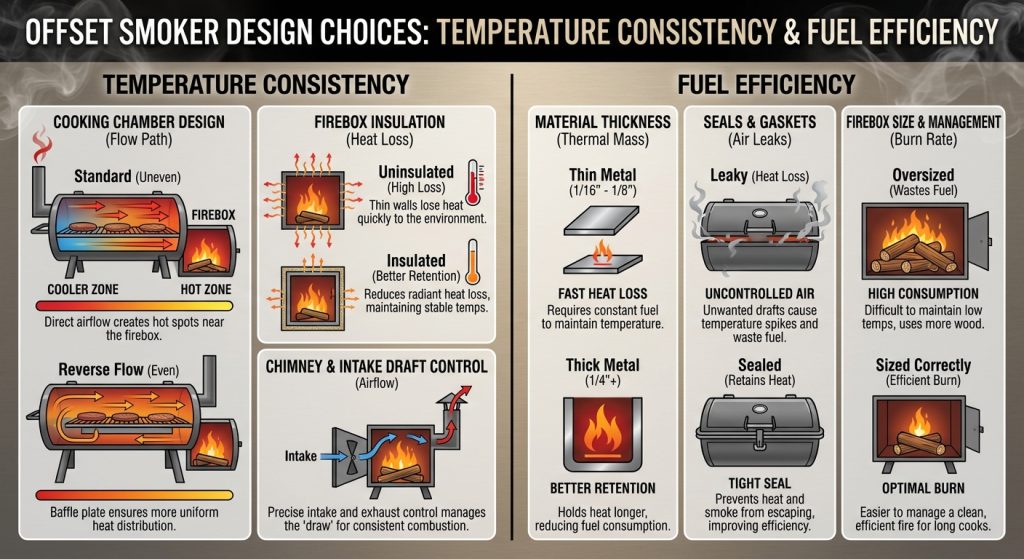
Offset smoker design choices significantly influence temperature consistency and fuel efficiency, and understanding these fundamentals improves your BBQ performance.
The performance of modern heating systems, appliances, and industrial equipment depends heavily on thoughtful design decisions made during development. In effective heating system design, two critical performance metrics consistently stand out: temperature consistency and fuel efficiency.
Temperature consistency refers to a system’s ability to maintain stable, predictable temperatures without large fluctuations. Fuel efficiency measures how effectively a system converts fuel into usable heat rather than waste. These two metrics are closely linked—design choices that improve one often enhance the other.
Understanding which thermal design principles most strongly influence these outcomes allows engineers, manufacturers, and end users to make informed decisions about system selection, installation, and operation.
Understanding Temperature Consistency in Heating Systems
Temperature consistency describes a system’s capacity to maintain uniform heat output over time and across varying operating conditions. It is typically measured by tracking deviations from target temperatures or fluctuation ranges over defined periods.
Consistent temperatures improve comfort, increase process reliability, ensure product quality, and reduce mechanical stress on components across residential, commercial, and industrial applications.
Key Factors Affecting Temperature Consistency
Thermal mass
Thermal mass is the amount of material available to absorb and store heat. Greater thermal mass buffers temperature fluctuations by absorbing excess heat during high-output periods and releasing it during pauses in combustion or heating cycles.
Material mass, density, and specific heat capacity all contribute, making material selection a foundational thermal design decision.
Heat distribution mechanisms
Heat distribution determines how thermal energy moves through a system and into the surrounding space. Effective distribution prevents hot spots and cold zones, promoting uniform temperatures.
This includes:
- Convective airflow patterns
- Radiant heat transfer pathways
Environmental Influences on Temperature Stability
External factors such as ambient temperature, wind, humidity, and barometric pressure significantly affect internal temperatures. Well-designed systems mitigate these influences and maintain stable output despite changing conditions.
Common instability issues include:
- Rapid cycling
- Slow response to load changes
- Uneven heat distribution
- Difficulty maintaining setpoints under variable conditions
Understanding Fuel Efficiency in Heating System Design
Fuel efficiency measures how much useful heat a system produces per unit of fuel consumed. It is usually expressed as a percentage comparing delivered heat to the theoretical energy content of the fuel.
Modern systems typically achieve 60–95% efficiency, depending on design. Condensing technologies reach the upper end by capturing latent heat from exhaust gases.
Economic and Environmental Benefits
Higher efficiency lowers operating costs and reduces emissions per unit of useful heat. These benefits have driven stricter efficiency standards and regulations across heating system categories.
Key Determinants of Fuel Efficiency
Energy conversion rates
Efficient systems convert chemical or electrical energy into heat with minimal losses. Complete combustion, optimal flame temperatures, and fewer intermediary steps improve conversion rates.
Heat loss prevention
Preventing heat loss keeps generated heat inside the system and directed toward useful output. Key elements include:
- Insulation
- Exhaust management
- Structural thermal barriers
Combustion or energy-transfer optimization
Fuel-burning systems rely on optimized combustion, while electric systems focus on efficient energy transfer. Both aim to maximize usable heat output.
Insulation Design Choices for Maximum Efficiency
Insulation is one of the most impactful design elements affecting both temperature consistency and fuel efficiency. Proper insulation reduces heat loss, stabilizes internal temperatures, and maximizes usable output.
Insulation Material Selection
Common insulation types include:
- Fiberglass and mineral wool – moderate resistance at reasonable cost
- Ceramic fiber and refractory materials – high-temperature capability
- Closed-cell foam and vacuum panels – high R-value in compact spaces
R-value measures thermal resistance, while thermal conductivity becomes more important at high operating temperatures.
Optimal Insulation Thickness and Placement
Increasing insulation thickness generally improves performance, but benefits diminish beyond a certain point. Economic analysis identifies a balance between performance, cost, and space.
Strategic placement prioritizes:
- External surfaces
- High temperature differentials
- Large surface areas
Common Insulation Design Mistakes
Avoid:
- Inadequate insulation around doors and access points
- Thermal bridges from gaps in coverage
- Compressed insulation reducing effectiveness
- Failure to account for thermal expansion
Combustion Chamber and Heat Exchanger Design
The combustion chamber and heat exchanger form the core of fuel-burning systems, directly determining how efficiently fuel converts to heat and how effectively that heat transfers.
Combustion Chamber Configuration
Key design considerations include:
- Adequate volume for complete combustion
- Geometry that supports flame development
- Sufficient residence time
Airflow design balances oxygen supply for complete combustion without excessive excess air.
Material selection balances durability, heat retention, and structural integrity. Refractory and high-mass materials improve combustion efficiency by maintaining elevated temperatures.
Heat Exchanger Design Principles
Heat transfer surface area
Larger surface areas extract more heat from exhaust gases, improving efficiency—though excessive area may cause condensation issues.
Flow path optimization
Baffles, turbulence enhancers, and directional changes increase heat transfer without excessive pressure drop.
Counter-flow designs
Opposing flow directions maintain a strong temperature gradient and improve overall heat transfer effectiveness.
Airflow and Ventilation Design
Proper airflow directly affects combustion efficiency and heat distribution.
Air Intake Design
- Primary air controls burn rate and heat output
- Secondary air completes combustion of volatiles
- Adjustable systems allow optimization across conditions
Insufficient air causes incomplete combustion; excessive air wastes heat.
Exhaust and Ventilation Systems
Draft optimization ensures efficient exhaust without excessive heat loss. Systems may use natural or forced draft.
Heat recovery captures energy from exhaust gases, with condensing systems exceeding 90% efficiency.
Structural and Material Design Choices
Material and structural decisions define thermal performance, durability, and long-term efficiency.
Material Selection for Heat-Exposed Components
- Thermal conductivity determines heat retention or transfer
- Durability and heat resistance ensure longevity
- Mass and heat retention stabilize temperatures
Structural Design for Heat Distribution
Intentional design of heat pathways and barriers prevents unwanted loss.
Thermal bridging, caused by conductive elements bypassing insulation, must be minimized using thermal breaks and strategic placement.
Control Systems and Automation
Automation significantly improves both consistency and efficiency through precise, continuous adjustment.
Temperature Control Mechanisms
- Proper thermostat and sensor placement
- Automated modulation instead of on/off cycling
- Fast response time and accuracy
Fuel Delivery Systems
- Precise metering maintains optimal air-fuel ratios
- Automated feeding improves stability in solid-fuel systems
- Consistent supply improves combustion quality
Size and Capacity Considerations
Proper sizing is fundamental.
Right-Sizing for Application
- Oversizing causes cycling losses and instability
- Undersizing prevents meeting peak demand
- Load matching ensures efficient operation
Volume-to-Surface Area Ratios
Compact shapes reduce heat loss. Cylindrical and cubic forms typically offer favorable ratios.
Sealing and Air Leakage Prevention
Air leaks waste fuel and destabilize temperatures.
Door and Access Point Design
- High-temperature gasket materials
- Replaceable and adjustable seals
- Loading mechanisms that minimize heat loss
Joint and Connection Sealing
Designs must accommodate thermal expansion without creating gaps. Accessible seals encourage maintenance and sustained efficiency.
Thermal Mass and Heat Storage Design
Thermal mass acts as a heat battery, smoothing fluctuations and extending usable heat delivery.
Heat Storage Capacity
High-mass materials store and release heat gradually, improving consistency and fuel utilization.
Passive Heat Distribution
- Optimized natural convection
- Radiant heat surface design
- Enhanced natural circulation pathways
External Design Factors
Environmental conditions and installation context influence performance.
Environmental Protection Design
- Weather protection without restricting ventilation
- Strategic installation location
- Seasonal adaptation features
Aesthetic vs Performance Balance
Successful designs integrate form and function without compromising thermal efficiency or usability.
Maintenance and Longevity Design
Long-term performance depends on durability and maintainability.
Cleanability and Access
- Accessible inspection points
- Easy cleaning of heat-exchange surfaces
- Efficient ash removal
Component Replaceability
- Modular design
- Accessible wear components
- Sustained efficiency over decades
Frequently Asked Questions
How does insulation thickness affect temperature consistency and fuel efficiency?
Thicker insulation reduces heat loss and stabilizes internal temperatures, improving both metrics—though returns diminish beyond a certain point.
What design choice most improves fuel efficiency?
Comprehensive heat-loss prevention—insulation, sealing, heat exchange, and proper sizing—offers the greatest gains.
Can consistency improve without affecting efficiency?
Yes, but many improvements benefit both. Thermal mass and advanced controls primarily enhance consistency.
How do materials affect long-term performance?
Durable, heat-resistant materials maintain efficiency and structural integrity over time.
What role does automation play?
Automation maintains tight temperature bands and optimizes fuel use through continuous modulation.
Key Takeaways
- Temperature consistency depends on thermal mass, insulation, sealing, and responsive controls
- Fuel efficiency relies on heat-loss prevention, optimized combustion, efficient heat exchange, and proper sizing
- Many design choices improve both metrics simultaneously
- Highest ROI improvements include insulation, sealing, right-sizing, and control accuracy
Future trends include advanced materials, smart controls, heat recovery, and performance monitoring systems that maintain efficiency over the system’s lifetime.